
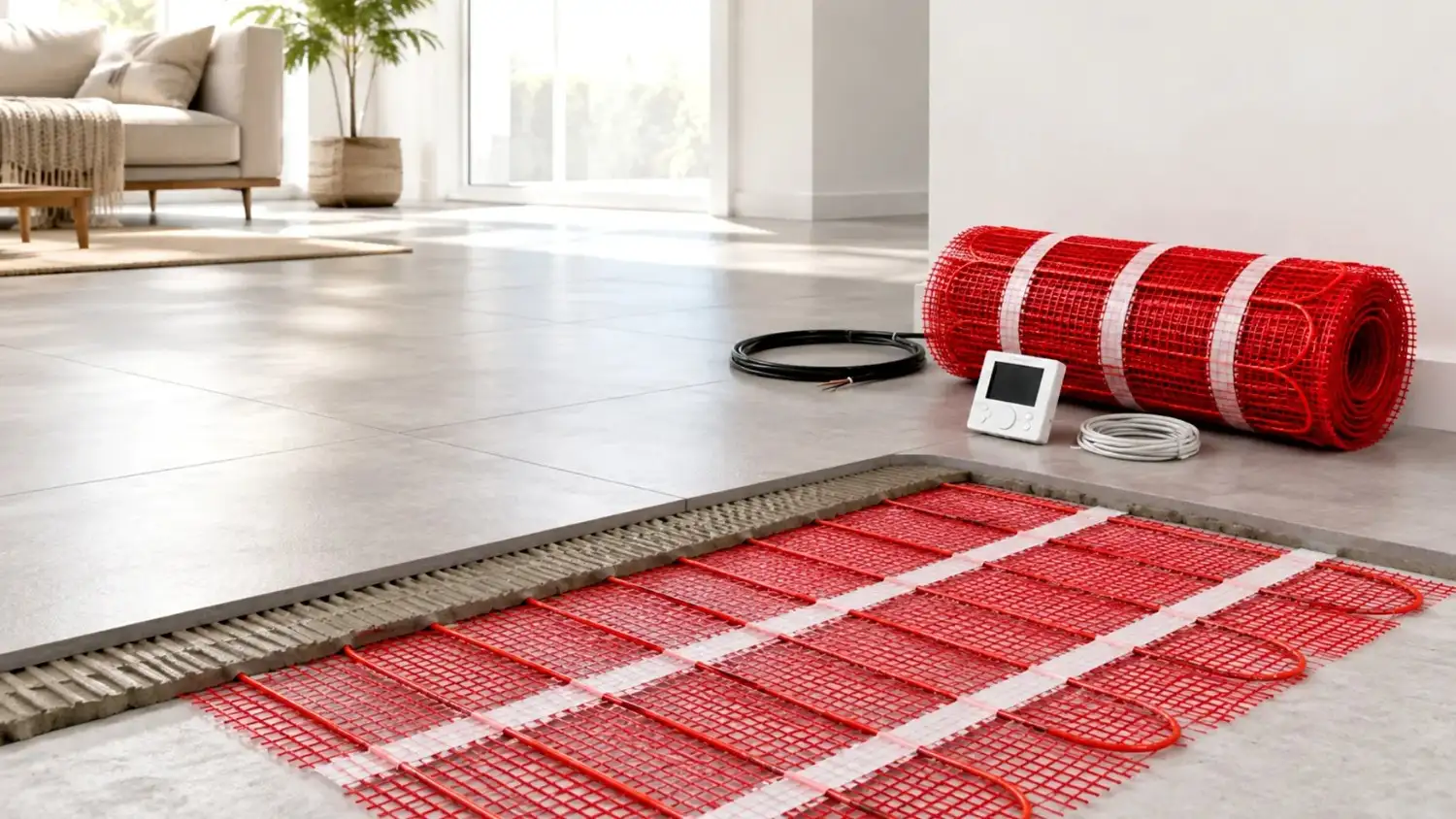
- Characteristics of Underfloor Heating
- Uses of Underfloor Heating
- About Ketswarm
- What Is Underfloor Heating?
- Hydronic vs Electric Underfloor heating: Which one is Better ?
- Which One Are you Supposed to Select?
- Hydronic vs. Electric Underfloor Heating: Which One Should You Choose?
- Room-by-Room Cost Considerations
- Underfloor Heating and Energy Efficiency: How Much Can You Really Save?
- Conclusion
One of such small luxuries that soon become a necessity is walking into a room with warm floors on a cold morning. That is the vow of underfloor heating, where the spaces are heated literally at the ground level. With the shift to smarter and more efficient heating systems in the homes and commercial spaces, underfloor heating became not only a luxury item in the niche, but also a popular selection of builders, designers and homeowners. The fact that it can provide uniform warmth at the same time as conserving energy and releasing wall space on the wall is one of the hottest heating technologies in the past twenty years.
Characteristics of Underfloor Heating
The underfloor heating systems are equipped with a number of functions that allow distinguishing them as compared to the traditional radiators or forced-air heating:
- Even heat distribution - the heat is distributed evenly over the whole surface of the floor, doing away with cold spots.
- Two different types: hydronic (based on water, with pipes), and electric (with cables or mats).
- Space saving design - there are no radiators or vents, so there is more wall and floor space to use.
- Flooring compatibility - can be used with tile, stone, engineered wood, and even carpet (with the appropriate underlay)
- Silent workings - no fans or blowers, therefore, no noise during operation.
- Zoned control - various rooms or areas can be heated separately to save on efficiency.
Did you know?
Ancient Romans employed a technology known as the hypocaust more than 2000 years ago whereby hot air was used in a furnace to heat bathhouses and villas by circulating beneath raised floors. Contemporary under floor heating is little more than a high-tech development of this primitive concept.
Uses of Underfloor Heating
There is no particular type of space that underfloor heating cannot be applied. Its applications include:
- Home locations - living rooms, bedrooms, particularly bathrooms and kitchens.
- New structures and renovations - more and more are being designed at the construction phase to enhance efficiency.
- Outside space - patios, walkways, and driveways to melt the snow and the ice.
- Wet zones Bathrooms and spas, where warm floors make it more comfortable and minimize the amount of moisture.
- Large, open spaces Open-plan spaces are advantageous because of their even heating without the need of a variety of radiators.
Some of the industries that are benefiting with underfloor heating include industries.
Although most obvious beneficiaries include homeowners, underfloor heating can be used by various industries not only to achieve comfort but also functionality:
- Hospitality - It is used in guest rooms, lobbies, and spas of hotels and resorts in order to provide comfort.
- Health care - hospitals and clinics apply it in the comfort of patients and to make indoor temperatures stable.
- Real estate and construction — developers apply it as a selling point to residential and commercial real estate as a premium.
- Retail This is used by showrooms and boutique stores to make the shopping atmosphere friendly and cozy.
- Agriculture - greenhouses and livestock facilities adopt underfloor heating to control the temperature to enable plants to grow as well as to ensure that the animals are comfortable.
Trivia:
South Korea has long has been practicing an ancient form of underfloor heating known as ondol where the heat of a wood fire is heated through flues made of stone underneath the floor. It is still in use today, occasionally in combination with modern boilers.
About Ketswarm
Ketswarm is a reliable supplier of wires, cables and heat tracing services, and specializes in heating wires, Teflon wires, PTFE wires and heating mats. Our residential, commercial and industrial clients include homes, hotels, offices, and specialty industrial use customers; and our products are designed to perform, be safe and durable.
Supported by a team of seasoned professionals, we provide customized, high quality solutions and support our clients with a high level of technical experience and individualized service. We just have one mission; we strive to bring innovation in the heat tracing business and assist our customers to succeed with the reliable and high quality solutions they can rely on.
What Is Underfloor Heating?
Fundamentally, underfloor heating is a design which transforms the floor into a massive, low temperature radiator. Rather than concentrating heat in a room by one source (such as a radiator on a wall) it heats the entire floor surface, which in turn radiates the heat evenly into the air. Two major types are
- Hydronic (water-based) systems - warm water is pumped through a system of pipes that are fitted under the floor, typically linked to a boiler or heat pump.
- Electric systems - a system of electric cables or mats is installed under the flooring that produces heat when electric.
Both systems operate under the same principle of radiant heat that is more natural and comfortable compared to the heat of traditional radiators that is based on convection.
Hydronic vs Electric Underfloor heating: Which one is Better ?
Both hydronic and electric underfloor heating provide an even, radiant heating, but operate differently and should be used in different circumstances.
Hydronic systems use a boiler or a heat pump to heat up warm water, which is circulated through pipes located under the floor. They fit well in big spaces and have less running costs in the long run, but installation is more complex - best on new construction or extensive renovations.
Electric systems involve heating cables or thin mats under the flooring. They are faster and simpler to retrofit, and are popular in smaller areas such as bathrooms, but more costly to operate in large areas.
Did you know?
The life span of a properly installed hydronic system is 35-50 years -it can even outlive the boiler it is attached to.
Which One Are you Supposed to Select?
- Hydronic - when building a new house, doing a major renovation or a large area where long term savings are important.
- Electric - single room retrofits or smaller areas that require a simple installation.
It all depends on your budget, scope of the project, and the portion of your home you are heating.
Hydronic vs. Electric Underfloor Heating: Which One Should You Choose?
How much will it really cost is one of the most frequent inquiries that homeowners have when it comes to underfloor heating. It all depends on the room, the type of system and whether it is a new build or a retrofit - however it is much easier to budget room by room.
Influencing Factors
It is good to know what makes the price:
- System type - electric systems tend to be less expensive to start off; hydronic systems are expensive to start but cheaper to run.
- Room size - bigger rooms will be more expensive to heat and equip.
- Current flooring - old flooring is removed or floor height increased, which increases labor.
- New build vs. retrofit - it is nearly always less expensive to install during construction than to retrofit an existing space.
Trivia: Bathrooms and kitchens are the most frequently installed rooms in the world to install underfloor heating, in large part due to the presence of tile and stone floors in those rooms which are the most effective at conducting radiant heat.
Room-by-Room Cost Considerations
Prices are quite different all over depending on the room- here is the way it usually goes:
- Bathrooms - The most frequented place to start off, as it is smaller and can have tile floors that are compatible with radiant heating. The best option in this case is electric mats.
- Kitchens -- A little bigger than bathrooms; electric or hydronic; it all depends on the size of the space and the rest of the house is heated as well.
- Living Rooms- They are one of the largest rooms and with this case, hydronic systems would be more appropriate to reduce the cost of running the entire house in case of heating the entire house.
- Bedrooms — Low priority as they are used less frequently, but either system works well, particularly in colder climates.
- Outdoor Areas (Driveways, Patios) — Require strong, weatherproof systems - typically hydronic - to melt snow and ice. Prices are increased because of the increased durability.
Budgeting Hint:
It is a good idea to begin with the high-impact rooms such as the bathroom and kitchen and then add the system later as budget permits.
Underfloor Heating and Energy Efficiency: How Much Can You Really Save?
The amount of savings will be determined by the type of system, insulation and the amount of daily use - however underfloor heating is usually more efficient than the conventional radiators.
Why it works better:
Radiators warms air by convection, thus, lifting warm air to the top and keeping the colder air at the bottom - where people are. Underfloor heating directly heats the floor and spreads heat equally around and at a lower operating temperature thus the system does not need to strain itself.
Although the precise savings depend on home, climate and the type of system installed, thousands of homeowners have reported significantly reduced heating costs since switching to underfloor heating - especially when the switch is from older, less efficient radiator systems. Even spread of heat, reduced operating temperatures and zoned control of the heating makes the underfloor heating one of the more energy aware heating options on the market nowadays.
Did you know?
Underfloor heating is usually efficient at only 21-24 C (70-75 F) at the floor level - way below the temperatures that radiators frequently require.
Conclusion
Underfloor heating, which was first invented by Romans, is one of the most efficient, comfortable and versatile methods of heating available today. It has features like even distribution of heat and compactness, which are beneficial and can be utilized in homes, hospitality, health and agricultural sectors, hence it is unsurprising that this technology keeps on gaining more popularity. Underfloor heating is a very attractive blend of comfort, efficiency and long term value whether you are constructing new or remodeling.
Wonder if underfloor heating is the correct choice to your room? Perhaps, it is high time to discuss it with a professional and learn.
Frequently Asked Questions
The amount of running costs varies with the kind of system, standard of insulation and the energy prices in the area. The hydronic systems tend to be cheaper to operate in the long run whereas the electric systems have lower initial set up costs but may be expensive to operate.
Flooring almost all types of flooring (tile, stone, engineered wood, laminate, and even carpet) are compatible, although the type of system and underlay used may have to be matched to the flooring to achieve the best performance.
This differs according to system. Electric systems are more likely to heat up quickly (in 30-60 minutes), whereas hydronic systems require more time to heat up but have longer duration of heating.
Yes, but it is less intrusive, and can be installed more easily during a renovation or new construction. Electric systems with low-profile are frequently used in retrofits because of little floor build up.
Yes, it is considered a luxury option in most markets that adds comfort and energy efficiency and can make a property more appealing to buyers.
Absolutely. As it does not have any exposed hot surfaces, sharp edges, or radiators, underfloor heating is deemed as being among the safest types of heating to use in homes which have young children or pets.